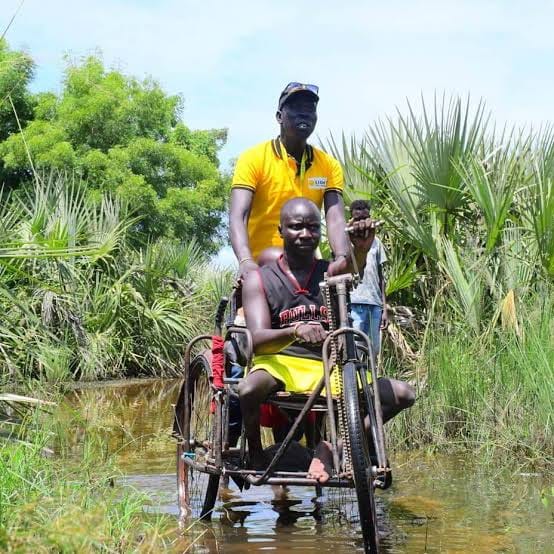
Stakeholders have called for deliberate and sustained measures to eliminate social, communication, physical and institutional barriers that limit the participation of persons with disabilities in economic empowerment and livelihood programmes.
The call was made during an economic empowerment training for livelihood and economic development partners operating in Nakivale Refugee Camp, Isingiro District. The training was organised by Humanity & Inclusion (HI) Uganda to strengthen stakeholders’ capacity to promote disability-inclusive programming.
Muzamil Ali, a disability rights activist from West Nile and an official of HI Uganda, said persons with disabilities have the capacity to participate effectively in agriculture, entrepreneurship and other livelihood activities and contribute to national development when provided with equal opportunities and an enabling environment.
Ali identified negative community attitudes and misconceptions about disability as some of the persistent barriers to inclusion. He also noted that limited access to information remains a significant challenge, particularly where programme materials and public information are not provided in accessible formats such as Braille, large print and other appropriate communication methods.
He further highlighted physical and institutional barriers, including inaccessible buildings, facilities and employment practices that may unnecessarily exclude qualified persons with disabilities.
Ali cited job opportunities that require applicants to have the ability to ride motorcycles, saying such requirements can disadvantage persons with visual and certain physical impairments even in circumstances where motorcycle riding is not an essential function of the position.
According to Ali, meaningful disability inclusion requires more than simply inviting persons with disabilities to participate in existing programmes. He called for organizations of persons with disabilities to be involved from the design and planning stages through implementation, monitoring and evaluation.
He said such participation would help ensure that livelihood interventions are responsive to the priorities, abilities and lived experiences of persons with disabilities.
Ali also urged parents and caregivers of children with disabilities to prioritize education, skills development and independence rather than keeping children at home under the guise of protection.
He warned that denying children with disabilities opportunities to acquire education and develop their abilities can increase dependency and vulnerability later in life, while limiting their potential contribution to their families and communities.
Meanwhile, Cecilia Kembabazi, the Office of the Prime Minister focal person for livelihoods in Nakivale Refugee Camp, called for stronger coordination between government institutions and organisations representing persons with disabilities.
Kembabazi said institutions, including the National Union of Disabled Persons of Uganda, the Ministry of Education and Sports, and the Ministry of Local Government, should strengthen collaboration to mainstream disability inclusion and improve access to essential services.
She particularly emphasised the need to ensure that persons with disabilities can access health facilities, financial services and other public services without facing unnecessary barriers.
Johns Abeine, the Isingiro District Assistant Chief Administrative Officer, commended Humanity & Inclusion Uganda for organising the training, saying it would enhance stakeholders’ understanding and capacity to address the needs of persons with disabilities.
Abeine urged developers, local authorities and other duty bearers to incorporate accessibility standards into buildings and public infrastructure to enable persons with disabilities to move freely and participate fully in community and economic activities.
The stakeholders emphasised that disability inclusion should be integrated into development planning and implementation rather than treated as an afterthought. They called for persons with disabilities and their representative organizations to be actively involved in decisions affecting their livelihoods, access to services and overall wellbeing.
More than 1,100 young people from Nakivale Refugee Settlement and neighboring host communities in Is... Read more
 News
Ankole Diocese is preparing for a leadership transition in 2027, when the current Bishop, the Rt Rev... Read more
 News
The National Identification and Registration Authority (NIRA) has launched ... Read more
a month ago
 News
The Public Procurement and Disposal of Public Assets Authority (PPDA) has p... Read more
2 months ago
 News
Police in Rukungiri have arrested a man in connection with the death of a 6... Read more
2 months ago
 News
Ugandans have been urged to use the upcoming Tusker Lite Rwenzori Marathon ... Read more
2 months ago
 News
Parliament’s Tourism, Trade and Industry Committee has launched an inquiry ... Read more
2 months ago
 News
Police in Kiruhura District have arrested five people suspected of belongin... Read more
2 months ago
 Kasese
Police in Kasese District are investigating circumstances surrounding the d... Read more
2 months ago